


Reimagining Rest: The Strategic Value of Leisure and Resting Zones in Modern Facilities
- 2025年11月27日
- 讀畢需時 4 分鐘
Introduction
Leisure and resting zones are no longer peripheral amenities. They have become structural components in facilities that aim to optimize visitor wellbeing, operational flow, and long-term commercial performance. Whether embedded in retail complexes, public buildings, or entertainment venues equipped with indoor theme park ride or an indoor play structure, the design of these zones influences everything from visitor dwell time to spatial efficiency. Their importance is rooted in ergonomics, environmental psychology, and spatial engineering.
The Functional Logic of Resting Zones
Well-planned resting areas operate as recovery nodes within high-activity environments. Visitors experience cognitive fatigue and sensory overload when navigating dense or stimulus-rich spaces. A calibrated rest zone lowers this burden. It stabilizes the visitor’s physiological state, moderates stressors, and improves decision-making capability. Short intervals of rest enhance the likelihood of continued participation in adjacent activities, especially in venues with complex indoor circulation systems.
These zones also serve as wayfinding anchors. They introduce spatial breathing room and predictable navigation points that reduce disorientation. This is particularly relevant in large-scale indoor entertainment facilities, where the presence of indoor theme park rides can create high-traffic pockets requiring deliberate dispersal.

Impact on Visitor Behavior and Experience
Rest spaces influence engagement duration. When visitors find accessible seating, shade, acoustic relief, or low-stimulation environments, they tend to prolong their visit. Longer dwell time correlates with increased secondary spending, greater attraction utilization, and improved visitor satisfaction scores.
The psychological effect is equally important. Resting environments act as micro-sanctuaries. Subtle design attributes—diffused lighting, controlled airflow, tactile surfaces—can substantially alter emotional perception. These components cultivate a sense of refuge, which counterbalances the intensity of entertainment or retail offerings.
Furthermore, parents accompanying children in an active zone featuring an indoor play structure rely heavily on rest areas. They allow supervision from a comfortable distance while providing ergonomic support, which enhances overall safety and reduces behavioral tension.
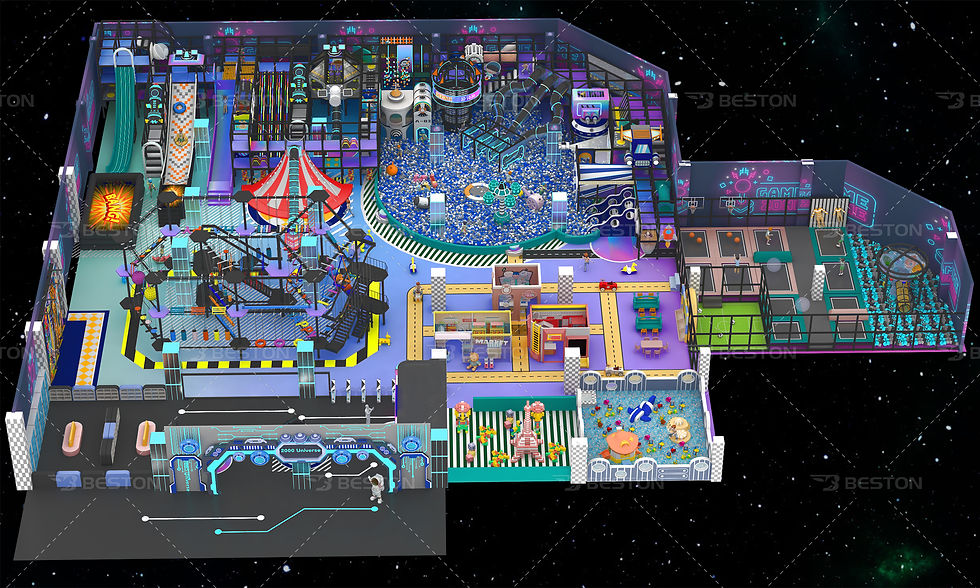
Design Principles for Effective Leisure Zones
1. Spatial Distribution
Resting areas must be strategically distributed based on activity density, sightlines, and movement patterns. Clustering them near bottlenecks, high-noise sectors, or peak-traffic intersections mitigates congestion and distributes footfall more predictably.
2. Ergonomic Considerations
The geometry of seating surfaces, backrest angles, circulation clearances, and edge radii must be designed with anthropometric data in mind. Ergonomically robust amenities reduce physical strain and encourage prolonged use without compromising mobility.
3. Environmental Modulation
Environmental factors—temperature gradients, reverberation control, lighting uniformity—directly impact user comfort. Resting zones should employ materials that diffuse sound, stabilize microclimates, and reduce visual glare. This is crucial in facilities where high-energy attractions such as an indoor theme park ride generate significant noise and vibration.
4. Visual Porosity and Safety
Resting areas must feel sheltered yet remain visually open. A balance between enclosure and visibility ensures comfort without compromising safety. This is particularly critical near an indoor play structure, where guardians require clear sightlines while still benefiting from low-stimulation seating.
5. Multifunctional Integration
In modern facilities, resting zones often incorporate charging points, hydration stations, or modular furniture. Multifunctional integration enhances perceived value and expands the practical utility of these spaces.
Operational Advantages for Facilities
Improved Traffic Management
Rest zones help regulate pedestrian flow by creating intentional pauses in circulation. They limit uncontrolled crowd buildup and function as buffer ecosystems between high-intensity zones.
Enhanced Maintenance Efficiency
Facilities with planned resting spaces experience fewer accessibility issues. Maintenance teams gain better control over cleaning cycles, litter concentration, and surface wear patterns due to predictable usage distributions.
Strengthened Commercial Performance
Resting zones indirectly stimulate revenue. Comfortable guests demonstrate higher purchasing propensity and are more likely to explore adjacent retail or F&B outlets after a restorative pause.
Extended Facility Longevity
By balancing high-energy areas with low-impact zones, overall structural stress decreases. Noise propagation is reduced, surface degradation slows, and mechanical systems function under more stable environmental loads.
Integration with Themed and Entertainment Environments
In entertainment-driven facilities, resting zones require thematic consonance. Their architectural language must harmonize with the narrative of surrounding attractions. A facility dominated by kinetic experiences—such as an indoor theme park ride—benefits greatly from rest areas that provide perceptual contrast.
Integrating natural motifs, soft materials, and biophilic accents can temper the engineered intensity of mechanical attractions. These design choices create a rhythm within the spatial experience, alternating between excitation and calm.
Resting zones also bolster operational reliability. Guests exiting high-energy attractions need decompression time, which lowers the risk of post-ride discomfort and reduces immediate queuing pressure on subsequent attractions.
Resting Zones for Family-Oriented Spaces
Family-oriented facilities rely extensively on these spaces. Parents supervising children at an indoor play structure require ergonomic seating, clean surfaces, stroller-friendly layouts, and controlled-viewing distances. Thoughtfully crafted leisure zones alleviate supervision fatigue and reduce the cognitive load associated with child monitoring.
This improved experience translates directly into repeat visitation rates and positive facility perception.
Conclusion
Resting and leisure spaces are functional infrastructure, not optional luxuries. They influence behavior, optimize traffic, reinforce safety, and elevate visitor satisfaction. When integrated into complex environments—especially those featuring an indoor theme park ride or an indoor play structure—these zones become operational stabilizers and essential contributors to commercial viability.
By prioritizing ergonomic precision, environmental modulation, and strategic spatial deployment, modern facilities can transform resting zones into high-value assets that enhance both experiential and operational outcomes.


留言